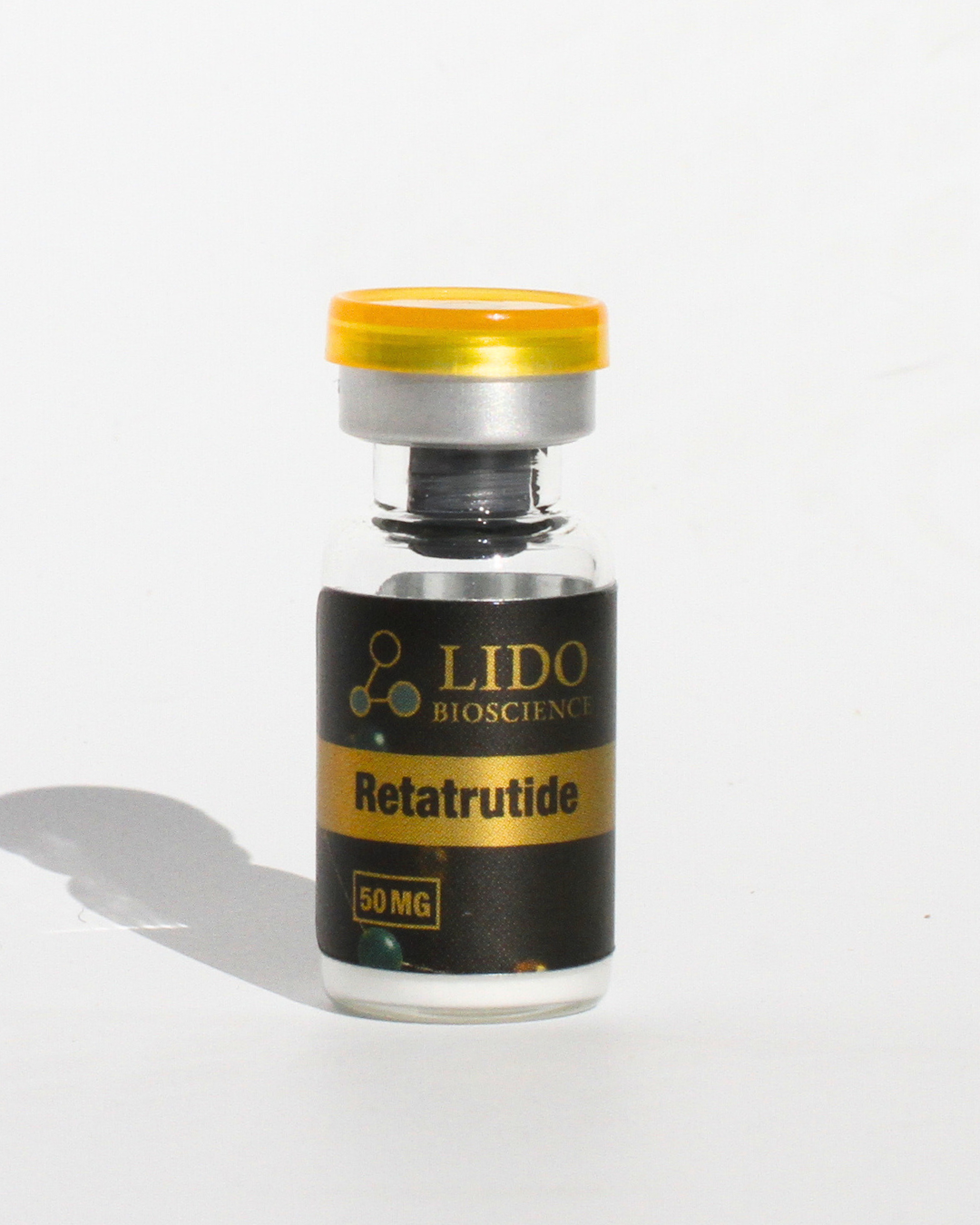
Retatrutide is a synthetic peptide that activates three receptors at once: GLP-1, GIP, and glucagon. Each of these receptors lives on a different metabolic pathway, and the hypothesis behind the triple-agonist class is that hitting all three at the right ratio produces a different metabolic profile than any single mechanism alone.
The published research on retatrutide spans rodent models, primate models, and phase-1 and phase-2 human trials. This guide walks through what each receptor does and where the data sits.
GLP-1 receptor: appetite and insulin response
The GLP-1 receptor lives on pancreatic beta cells, where its activation amplifies insulin release in response to food, and on hypothalamic neurons, where its activation reduces appetite. The receptor also slows gastric emptying, which extends the post-meal satiety signal.
Native GLP-1 has a half-life of about two minutes because it is rapidly degraded by an enzyme called DPP-4. Retatrutide is structurally modified to resist DPP-4 cleavage, which extends the duration of action to roughly six days in humans.
GIP receptor: incretin amplification
GIP, or glucose-dependent insulinotropic polypeptide, is the second major incretin hormone. Like GLP-1, GIP amplifies insulin release after a meal. Unlike GLP-1, the effect of GIP on appetite and body weight has been ambiguous in the literature.
The most current research suggests that GIP receptor agonism, when paired with GLP-1 agonism, produces a synergy that single-mechanism molecules cannot achieve. The retatrutide molecule activates GIP at a ratio relative to GLP-1 that the design optimized for body-weight effects rather than glucose effects alone.
Glucagon receptor: energy expenditure
The glucagon receptor adds a counterintuitive piece. Glucagon raises blood sugar by signaling the liver to release stored glucose, which sounds like the wrong direction for a metabolic therapy. But glucagon also increases basal metabolic rate, promotes lipolysis, and shifts the body toward burning fat rather than storing it.
The retatrutide molecule activates the glucagon receptor at a ratio that produces an energy-expenditure signal large enough to matter, while the simultaneous GLP-1 amplification offsets the glucagon-driven rise in blood glucose. The net effect in published trials has been larger reductions in body weight than dual GLP-1 and GIP agonists at comparable doses, with comparable glycemic control.
What the human data shows
Phase-1 and phase-2 human trial data has been published in peer-reviewed journals, with the New England Journal of Medicine carrying the most-cited paper on the molecule. Reported outcomes include body weight reduction in the 17 to 24 percent range at the higher tested doses over 48 weeks, improvements in liver fat and HbA1c, and an adverse-event profile dominated by gastrointestinal symptoms similar to other incretin agonists.
Phase-3 trials are ongoing as of the date of this article. Regulatory approval status, in any jurisdiction, is what determines whether the molecule is available as an approved therapy.
Open questions
Several questions remain active in the literature: the long-term safety profile beyond 48 weeks, the effect on lean-mass preservation during rapid weight loss, the effect on bone-mineral density, and the durability of effect after discontinuation. Most of these are typical for any novel metabolic peptide and are the focus of the ongoing phase-3 program.
A note on framing
Retatrutide is sold by Lido BioScience as a research peptide, not as an approved medication. Published clinical data exists, but the molecule has not been approved for therapeutic use in the United States or elsewhere as of this writing.
Pregnancy, a personal or family history of medullary thyroid carcinoma, and MEN-2 are contraindications for the GLP-1 receptor agonist class as a whole. If you are evaluating retatrutide for any clinical situation, that decision belongs with a physician.